
Bringing Purpose to a Game
The concept of sport has become more than the realm of a game. With various avenues to explore sport, this has driven individuals to participate within the industry. 35% of the technophiles of the world are using the internet to stream and enjoy sport (Mander, 2019). Through my studies at university, I am eager to analyse the aspect of how technology has developed and advanced the world of professional sports. As this platform enables me to compare and contrast, basing my research on how our society who are considered to be living within the information age (Dizard, 1981) can connect to the world beyond the screen, becoming the knowledge workers (Drucker, 1999) of our technocultures within the economy (Green, 2002).
Combining our Societies Culture with Technology
Technoculture, a foreign term for most individuals. Although cultural theorist, Debra Shaw (2008) explains that it is “an enquiry into the relationship between technology and culture and the expression of that relationship in patterns of social life, economic structures, politics, art, literature and popular culture” (as cited by (Flew, 2014)). For this reason, the construction of new technologies supports the development of new applications and resources that stimulates technology within a culture.
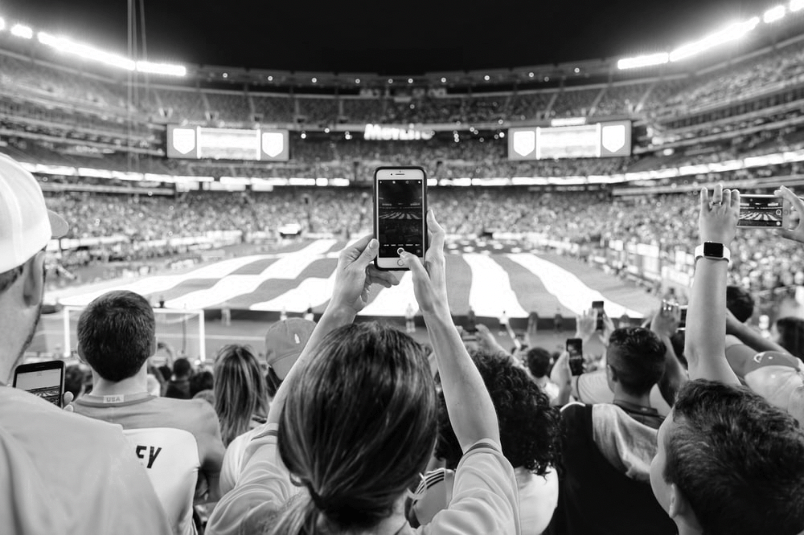
To understand the relationship of technoculture in regard to professional sports, it can be articulated in the simplest form that it is the technological applications that aid the culture of professional sports. The use of these technologies has enabled to transcend the time and space of sports culture, thus promoting the audience to become active participants within the game.
There are various applications that are now full facilitators of sport, in that they are the structural and broadcasting platforms for the industry. “The Hawk-Eye is one such technology which is considered to be [a] really top indentation in various sports” (Baljinder Sing Bal., 2012). The Hawk-Eye has become a key facilitator for many as it has the ability to monitor the entirety of a game. This application was developed for the purpose of broadcasting but soon after realising the full degree of effect, many governing bodies adopted the resource to become the overriding decision maker, to counter for human inconsistency physically being unable to determine all results. This technology has also been utilised for analysis purposes, as it conditions the professional to be held accountable for their performance. It also permits the distribution of data and information, thus promoting coaching staff to platform training around the areas of improvement. From this evidence, the artificial judgement has been regarded to have “superb decision-making power” and is continuing to be explored as a utility in more sports as it becomes further developed.

The Degree of Involvement … Technology Determining our Future
Through the integration of such technologies discussed, this interconnects with how an individual partakes within their technoculture. As a society that is heavily influenced by technological change, the concepts of technophilia and technophobia are manipulated through bias, hence determining how technological determinism is conceded. Robin Williams (1996) defines technological determinism as a view that “research and development have been assumed as self-generating. The new technologies are invented … in an independent sphere, and then create new societies or new human conditions”.
This human condition is displayed within the extent of the extreme technological determinists to the voluntarists of technology (Chandler, 1996). These levels of involvement control the behaviour of society and the extent of engagement within the professional sports culture. It can be noted that the difference in how technology controls change, to how an individual pursuing change can decipher our generations. Across all the demographics who view sport online, it can be identified that the Baby Boomer’s engagement with technology ranges between a low 4-17%, whereas the Millennials and Generation Z are seen to be the biggest contenders with up to 46% investing both time and expenses into the internet to be able to participate within the industry (Mander, 2019).
These statistics can fuel the ideology that surrounds the way technology has influenced the dire change over the decades. That as we continue to invest in the exploration of technology, it becomes that we are no longer the voluntarists that we were from mid 1900s, we now have converged for the growth of our economy. That again, our professional sports culture, is more than a game, it is a part of a global system, it is what contributes to our knowledge economy (Drucker, 1999).
Is it the Diffusion or Disruption that is Aiding our Professional Sport?
According to Rogers and Kincaid (1981) “most past diffusion studies have been based on a linear model of communication … but other types of diffusion are more accurately described by a convergence model, in which the participants create and share information with one another to reach mutual understanding”. For the scene of professional sports, the diffusion model has been produced though the development of global networks such as the internet. As 56% of the industry’s audience stream through a device (Mander, 2019). The communication line is propelled through globalisation, as the understanding is now based upon one’s access to more than a game … it is who they follow, on what devices, where and when. It is at what stage the individual is at in regard to adopting the innovation.
The diffusion rate of sports technology is that of its participants. For most, it is the scope to be involved within the homophily of their sport. The early adopters enable the ability for the technology to process and facilitate the streaming of the sport. If their involvement is to cease to exist, this would result in the process of rejecting the innovation.
Can it be expounded that the aiding of a diffused technoculture such as the streaming of professional sport is in fact stimulated by the disruption of technology? This model has transcended the capabilities to connect the adoption of new practices, technological innovations to explode the sporting industry beyond the capacity of a field, court, pitch or pool.

The Point of Convergence
Convergence can be regarded as “… the flow of content across multiple media platforms, the cooperation between multiple media industries …” (Jenkins, 2006). The point of convergence is based on the three key elements of how the social, digital and commercial world of professional sports interlink to create a merging industry. Through the disruption of technology, in the instance of the internet, trading for global companies has only continued to expand. The function of the converged technology is to make the monotony of human life simple and efficient.
Through computer mediated communication, this has capacitated the ability for the uncritical euphoric stance (Brand, 2020) to be adopted. Socially, for sports, through media platforms professionals are connected to their audience. Such companies like Facebook who are exclusive to the Fortune 500, are continuing to grow through the exposure of consumers. Through utilising their application to live vicariously through the livelihood and successes of highlighted professional athletes and teams. Digitally, the streaming of competitions and events through various pages and individuals’ profiles alone continues to add to the publication process of the company. Commercially, Facebook’s industry growth has accumulated exponential opportunity to continue to network within the marketing sector of business. Through endorsements and contracts with sporting professionals, both parties gain intangible capital through a brand that is exclusively accessible via the social media platform. As a consequence, convergence publicises the sports industry to become an augmentation of digital media.
What is a Knowledge Worker and What Impact Does This Have on Our Economy?
“ … Drucker (1959) defined knowledge workers as high-level workers who apply theoretical and analytical knowledge … he noted that knowledge workers would be the most valuable assets of the 21st century organisation because of their high level of productivity and creativity” (Institute). Drucker’s theory would transcend the decades and shape how our economy would exist to function, facilitated by a digital process. In distinction to this theory, (Holtshouse, 2009) argues that by where we are now in 2020, our knowledge economy will be exacerbated by the retirement our knowledge technicians, the Baby Boomers. Which with “the loss of critical knowledge” this will impact the access to industry experience thus affecting the knowledge economy in its entirety.
For the 21st century economy, the roles of the knowledge worker have been constructed and materialised to ease this perception of fear. That in losing experience as well as competing against the advancing artificial intelligence is a worry that can be resolved. This for most industries, including professional sports, has evoked roles for humanistic nature to cultivate how information can be synthesised. Our knowledge workers to outweigh and overcompensate in every facet of their industry.
The hypercapitalism (Graham, 2002) of athletes and teams can be determined by their level of participation within the economy. An example of this can be made of E Sports. As a weightless export, it has initiated the intangible capital for the gaming industry to progress and extend once more beyond a game of sport. This encourages the knowledge workers to focus on the detail of consumer desires as well as to continue to produce new ideas from analysed information. Therefore, making the connections of how a relationship is formed between various interfaces of the application.
It is More Than a Game
From the information and insights gained, it can be concisely assessed that the professional sports culture is more than a game. As an industry, it has provoked many avenues to establish a connection between the professionals and the audience. Going beyond a screen, the wealth that is generated and thus accumulated can be a base that as a society, we as consumers are technologically determined by applications and it is only going to continue to grow over the coming decades. What an exciting realm to be involved in, a progressive future that lies ahead.

Podcast: https://soundcloud.com/miahosssss/miah-osullivan-podcast
References:
Baljinder Sing Bal., G. D. (2012). Hawk Eye: A Logical Innovative Technology Use in Sports for Effective Decision Making. Sports Science Review, 13.
Brand, J. (2020, Feburary). End-to-End Digital. Gold Coast, QLD, Australia: Jeff Brand.
Chandler, D. (1996, Feburary 1st). Shaped and Being Shaped . Engaging with Media: Shaped and Being Shaped . CMC Magazine .
Dizard, W. (1981). he Coming Information Age: An Overview of Technology, Economy, and Policy.
Drucker, P. (1999). Knowledge-Worker Productivity: The Biggest Challenge. Sage Journals.
Evatt Rogers, L. K. (1981). Communication Networks: Towards a New Paradigm for Research. New York.
Flew, T. (2014). New Media Fourth Edition . Melbourne : Oxford .
Graham, P. (2002). Hypercapitalism: language, new media and social perceptions of value. Sage Journals .
Green, L. (2002). Technoculture: Another Term That Means Nothing and Gets Us Nowhere? Sage Journals.
Holtshouse, D. (2009). The Future of Kowledge Workers Part 1 . KM World , 28-29.
Institute, C. F. (n.d.). What are Knowledge Workers? Retrieved from Corporate Finance Insitute : https://corporatefinanceinstitute.com/resources/knowledge/other/knowledge-workers/
Jenkins, H. (2006). Convergence Culture: Where Old and New Media Collide.
Mander, J. (2019). Sports Around the World. Global Web Index . Retrieved from Global Web Index: https://www.globalwebindex.com/hubfs/Downloads/Sports_Around_the_World.pdf?utm_campaign=Sports%20Around%20the%20World%202019&utm_source=hs_automation&utm_medium=email&utm_content=80500213&_hsenc=p2ANqtz-8mMQTR3Epe3rvHmjRzhWvS8X44YdpY1rBuSZvEO–3lkzq3RAWts
Shaw, D. (2008). Technoculture: The Key Concepts . New York : Berg.
Shaw, D. (2014). Technoculture. In T. Flew, New Media (p. 41). Melbourne: Oxford.
Williams, R. (1996). The Social Shaping of Technology. Research Gate.
 Miah's Blog